The history of Bornheim was shaped not only by events, but above all by its inhabitants. Over centuries, life in the village was strongly determined by agriculture. Everyday life was structured by the seasons, harvest times, and church festivals. Work and community went hand in hand.
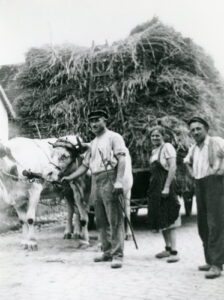 The chronicle shows that life until the 20th century was simple and labor-intensive. Water was drawn from wells, heating was done with wood or coal, and many distances were covered on foot or by cart. Children helped early on in the household or in the fields. At the same time, festivals, the Kerwe, club life, and neighborly assistance shaped social interaction. Those who built or harvested could rely on support — community was the basis of survival.
As early as the 18th century, the Bornheim citizen Georg Wagner represented the region as a member of the Rhenish-German National Convention and stood for political reforms.
One name that is inseparably linked with municipal development is Erhard Groß. As a long-serving mayor, he played a decisive role in shaping the early 1960s and the phase of structural change. During his time in office, important infrastructure measures were carried out and Bornheim continued its development into a modern residential community. His work stands for continuity and reconstruction in a time of profound change.
Mayor Dieter Hörner also combined municipal responsibility with nature conservation. As co-initiator of the resettlement of storks and chairman of the “Aktion Pfalzstorch”, he helped make Bornheim known beyond the region.
Economically, the Hornbach family stands for entrepreneurial courage. With the first combined DIY and garden center in Bornheim, a company was created that gained international importance — with strong roots in the village.
The history of Bornheim shows: village life has always been shaped by work, cohesion, and responsibility — and by individuals who emerged from this community and developed it further.