
The beginnings of viticulture in Bornheim date back to around the year 900. At that time, two Fuder of wine were mentioned as a levy to the Bishop of Speyer. A Fuder is an old unit of measure of approximately 1,000 liters.
Establishing a vineyard (Weingarten / Wingert) was once extremely labor-intensive. The Kammertbau method used in the region required deep clearing of the soil as well as the procurement of stakes and poles, since wire did not yet exist. Slender, straight-growing sweet chestnut shoots were best suited for this purpose. It is assumed that the Romans introduced sweet chestnut trees to the Palatinate because of this cultivation method. Due to the labor-intensive nature of this system, winegrowers were only required to deliver rent after ten years.
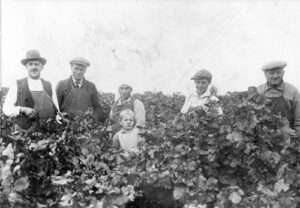 As early as the Middle Ages, the Southern Palatinate developed into an important wine-growing region. Monasteries and nobility strongly promoted cultivation, as wine was a highly sought-after commodity. That wine was also cultivated in Bornheim is evident from entries in the Bornheim Seelbuch of the years 1464 and 1525. These records refer to the parish priest and church property, which also included a vineyard. The yields were used to cover the costs of maintaining the church and to produce sacramental wine.
In the early Middle Ages (around 1000 to 1500), vines were planted in what was known as a “mixed set,” in which different varieties were harvested and pressed together. Dominant varieties included Räuschling, Gelber Orleans, and Grünfränkisch.
From the late Middle Ages into the early modern period (around 1500 to 1900), the “Little Ice Age” forced winegrowers to cultivate more cold-resistant and earlier-ripening varieties. From the 18th century onwards, Riesling gained great importance due to its quality. High-yield but lower-quality varieties such as Heunisch were replaced by Silvaner.
 From the 20th century to the present day, many new varieties have spread, such as Müller-Thurgau, Kerner, and Scheurebe. In the 1970s, Dornfelder became the most important red wine variety in the Palatinate.
The development of viticulture in the Palatinate was significantly disrupted by the introduction of new vine diseases from America. In particular, phylloxera required new cultivation methods. By grafting noble vines onto phylloxera-resistant rootstocks, the problem was overcome.
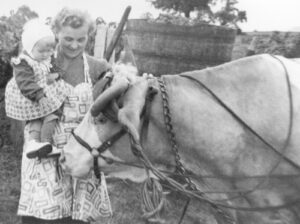
From around 1880, the wooden poles used in the Kammertbau system were replaced by wire. With the elimination of crossbars, it became possible to use horses and ploughs.
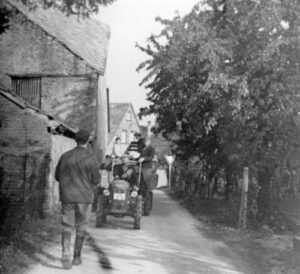 Today, vine rows are spaced two meters apart, with a planting distance of 1.20 meters. This allows the use of machinery such as mulchers, cultivators, subsoilers, and even full harvesting machines.