
School education in Bornheim developed over centuries in close connection with the church, the municipality, and social change. The first indications of school instruction date back to the time of the Reformation. While in 1556 there was still talk of a lack of schooling, shortly afterwards there already existed a school with a Protestant schoolmaster. With the Counter-Reformation, Catholic educational structures developed in parallel, so that Bornheim maintained two denominationally separate schools for a long time.
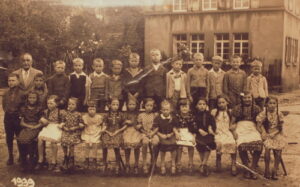 Both denominations had their own school buildings. The Catholic schoolhouse was located next to the old rectory in the lower village. Today, the inn “Zum Lehrer Lämpel” is located there. The Protestant schoolhouse stood near the Protestant church in the upper village. Both buildings housed a classroom, a teacher’s residence, and ancillary buildings. In 1826, the municipality built a shared schoolhouse in the lower village, in which both denominations were taught under one roof, but still separately. Due to increasing numbers of pupils, a new separate Protestant schoolhouse with a large school hall and a teacher’s apartment was built in 1867. This building still exists today and has served as the town hall of the municipality of Bornheim since 1991.
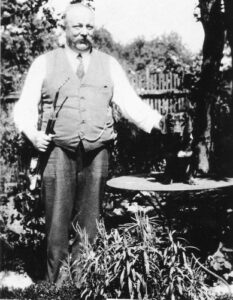 Lessons covered all age groups within a single class. Reading, writing, arithmetic, and religious instruction formed the foundation, supplemented by singing and practical activities. Teachers were often employed by the church and additionally performed duties as sextons, organists, or municipal clerks.
The political upheavals of the French Revolution brought profound changes. For a short time, a religion-free school system was introduced, before denominational structures again prevailed under Napoleonic and later Bavarian administration. From 1817 onward, responsibility for the schools lay with the municipality, while ecclesiastical school supervision remained in place.
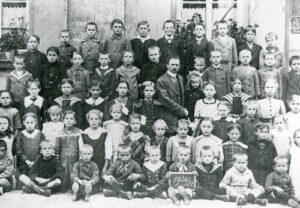 An important step took place in 1824 with the establishment of a free school: school fees were abolished, and the municipality permanently provided funds for the operation of the school. Only with the introduction of the Dammheim–Bornheim joint school in 1964 did teaching in the historic school buildings finally come to an end.
The history of school education in Bornheim thus reflects not only pedagogical developments, but also the denominational, political, and social changes of a village undergoing transformation over time.