
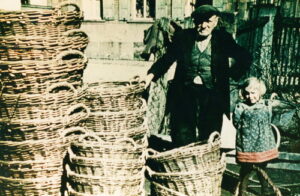
 In addition to viticulture, there were other trades in Bornheim that provided the inhabitants with a modest income. These included, for example, basket makers. They wove baskets for farmers and winegrowers and also traded them. At that time, the people of Bornheim were also teased as “the baskets.”
Blacksmiths shoed horses and produced barrel hoops as well as fittings for doors and windows. The charcoal burner supplied the charcoal for the forge. In the past, the charcoal path ran through the northeastern edge of Bornheim’s district into the Essingen forest. Today it is known as the “Kälberpfad.”
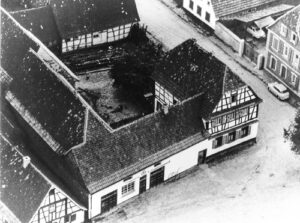 Wood was the predominant building material for houses, farms, and agriculture. It was used for house construction, interior fittings, and farming tools such as wagons, carts, ploughs and harrows, as well as handles for hoes, forks, and rakes, and for tubs and barrels. In 1807, the municipality of Bornheim planted 600 acacia trees in what is now the industrial area. The tough wood was needed, among other things, for the production of wheel spokes. The “Wagnerei Messerschmitt,” located opposite the town hall, can still be seen today and is now a listed monument.
Even in 1926, Bornheim still had a bakery, two grocery stores (spices, sugar, coffee, tea, cocoa, tobacco, etc.), one tailor, three seamstresses, two wheelwrights, two carpenters, one cooper, the carpentry and timber business Sommerauer, two tinsmiths, two hairdressers, two shoemakers, one painter, and the basket weaver Heinrich Cattor. In addition, butchers, cabbage cutters, milk traders, and masons earned extra income as secondary occupations.
In 1953, the municipal council of Bornheim decided to designate less fertile land south of the railway line as a commercial area. This decision proved to be a stroke of luck for the community. Within a few decades, a dreamy farming village developed into a prosperous community.