
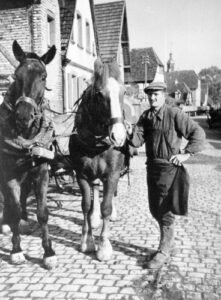
 When the first inhabitants settled in Bruneheim, as Bornheim was formerly called, they had to provide for themselves. As soon as the village grew larger and the fields had to supply more people and, in addition, the annual tithe had to be paid to the feudal lords, the original method of cultivation was no longer sufficient.
From the 11th century onwards, the three-field system became established in the Southern Palatinate. In a three-year cycle, the fields were used for winter grain such as rye or spelt, summer grain such as oats and barley, or left fallow for grazing livestock. The soil was able to recover, and fertilization by the animals prepared it for planting again the following year. In home gardens, beans, peas, lentils, as well as cabbage and turnips were grown for self-sufficiency.
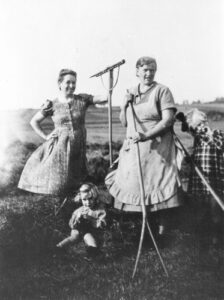 Even in the last century, Bornheim was still a village shaped by agriculture. Potatoes and grain were the dominant crops. Potato cultivation in Bornheim is documented for the year 1760. In the 19th century, the potato was considered the “bread of the poor.”
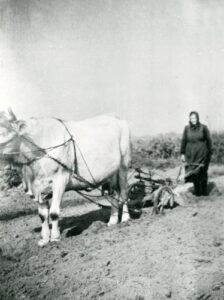 Another source of income was livestock farming. Horses and cattle, also used as draft animals, sheep and pigs, goats and rabbits, as well as chickens, geese, and ducks were kept in large numbers in Bornheim.
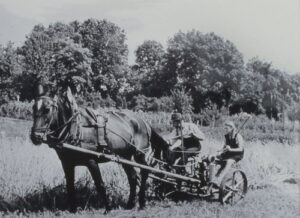
Fieldwork was still characterized by a great deal of manual labor. Although the plough was pulled by horses or oxen, the harvest was carried out by hand with the sickle or scythe, the grain was tied into sheaves, and threshed at home with the flail. From 1913 onwards, with the introduction of electricity, the threshing machine came to the village, which made threshing grain faster and more efficient.
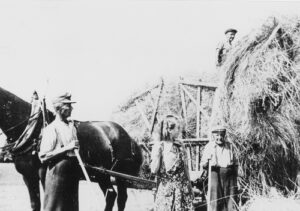 Another easement came in the early 1950s with the introduction of tractors, which quickly became widespread. By the end of 1956, Bornheim already had 15 tractors. The air-cooled “Bulldogs,” with their great pulling power, increasingly made horses and oxen unnecessary.
 Further technological developments with seed drills, larger ploughs, and combine harvesters, as well as crop protection and artificial fertilizers, boosted agriculture. As a result, yields per hectare more than doubled.