Past and Present
 For decades, the white stork was considered extinct in the Palatinate – the last recorded breeding was documented in 1973 in Offenbach an der Queich. Since the late 1960s and early 1970s, conservationists have been committed to its return. The association “Aktion PfalzStorch e.V.,” founded in 1998, has since pursued the goal of permanently re-establishing the white stork in the cultural landscape, which has been successfully achieved. It continues to engage in nature conservation and environmental education in order to preserve a livable environment for both storks and humans. The initiative stands for “nature conservation with the stork,” supported by research, environmental education, and voluntary commitment.
Habitat and Meadow Irrigation
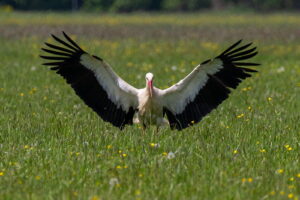 The return of the white stork was only possible because its habitat was secured. As a species that follows human-shaped landscapes, it depends on extensively used meadows rich in food. Of particular importance are the Queich meadows with their traditional meadow irrigation. This old method creates alternating wet conditions and promotes a high level of biodiversity. Today, up to 400 white storks can be observed there on some days.
Stork Center and Stork Barn
 The Rhineland-Palatinate Stork Center in Bornheim is the headquarters of “Aktion PfalzStorch.” The permanent exhibition there clearly presents the biology of the white stork, the historical and current use of the meadows, the importance of the cultural landscape, and the myth of the stork.
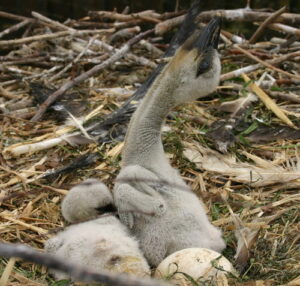 The stork barn plays a special role. It serves as a care station for injured or weakened storks and makes visible the connection between individual animal care and the protection of the entire population. Together, the stork center and the stork barn stand for lived species protection and, as a certified “Place of Learning for Sustainability,” offer a wide range of educational programs.
The White Stork in the Palatinate – Return and Protection
From disappearance to return
1973: For the last time, a breeding of the white stork was documented in the Palatinate. After that, the species was considered extinct in the region.
From 1997: A targeted reintroduction program began in Bornheim. Young storks from other regions were raised in aviaries and released after an acclimatization period. In this way, they learned to recognize the location as their new home.
1998: With the founding of “Aktion PfalzStorch e.V.,” the project received a solid organizational basis. Since then, the reintroduction has been permanently secured through research, care, and environmental education.
Today: The white stork has become re-established in the Palatinate. A stable population – that is, a reproductively viable group – now lives and breeds here permanently.