The people of Bornheim, with their strong sense of community, have always known how to celebrate together. While in earlier times it was mainly slaughter festivals and church fairs that were celebrated extensively each year, over time more and more occasions were added that could be celebrated together in a festive way.
Carnival customs with masked processions have been historically recorded in the Palatinate and date back to the 14th and 15th centuries. These originally marked the beginning of the strict 40-day fasting period. Modern carnival only developed after the Napoleonic Wars. Bornheim carnival is closely connected with the association “Freundeskreis Die Wachthäusler,” which, since the late 1990s, has regularly invited people together with other local clubs to the “Bornemer Fasenacht” in the community center.
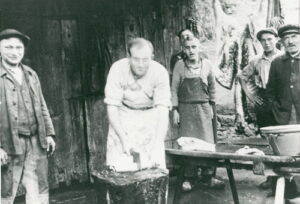 In spring and autumn, animals were slaughtered, and the people of Bornheim celebrated these slaughter festivals extensively with “Weck, Worscht und Woi” (bread rolls, sausage, and wine). The traditional harvest festival is celebrated every year at the beginning of October. At this church festival, thanks have been given for a successful harvest for centuries. The Bornheim wine fair (Weinkerwe) is another highlight in the extensive calendar of festivities. For four days, from Friday to Monday, people celebrate extensively. Since 1997, a high-class cycling race, the “Kerwerennen rund um den Saubrunnen,” has been held as the closing event.
In recent years, additional occasions for celebration have been added, such as the Hexennacht tournament of the boules club “Nooh draa” and the Storchencup of the women’s handball teams of SV Bornheim. People also meet at the flea market of the Tierinsel, where tasty food and delicious cakes are offered.
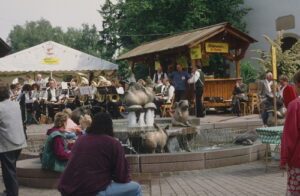 A festival that unfortunately no longer exists is the Saubrunnenfest. From 1989 to 2014, it was celebrated every year one week after Pentecost around the Saubrunnen. The festival was opened with 100 free glasses of wine tapped from the pig. For this purpose, when the fountain was built, a wine pipe had been installed from the pig with the small barrel on its back into a shaft beneath the fountain. To cater for the guests, one pig per day was grilled over three days on a specially constructed grill fired with vine wood. The helpers had to start work in the middle of the night from 2:00 a.m., lighting the grill and preparing and turning the pig so that it was ready by midday. Many clubs were involved in making the festival possible. This shows that community does not come by itself: those who work hard to organize celebrations are also entitled to celebrate properly.